
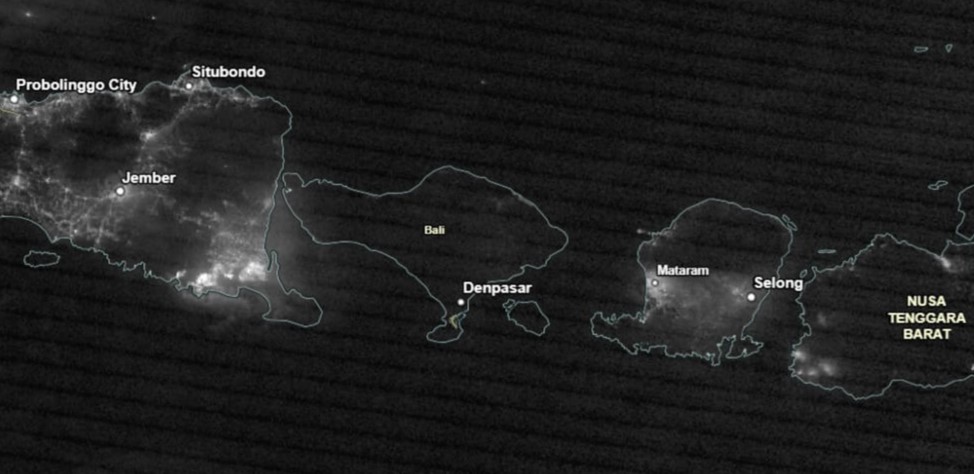
Nyepi Day – Day of Silence – is the only day on the island when Bali comes to a complete standstill: all establishments are closed, there are no people on the streets, the airport is closed, street lights are turned off. And the streets are patrolled by Pecalang, who enforce the rules.
In 2025, Nyepi Day fell on March 29. I spent Nyepi Day in Bali and saw with my own eyes how a tourist island of millions plunges into absolute silence and darkness. In this article, I’ll talk about a chance encounter with the Pecalang, satellite images of Bali on Nyepi Day, air travel data, and video analysis of the night’s silence.
Bali Nyepi a day from space: observing darkness from above
Nyepi Day is the only day of the year when the island of Bali practically disappears from the Earth’s nightlife map. And I thought it was the perfect option to see what Bali looks like on the Day of Silence from a bird’s eye view. My first idea was to use my DJI drone, but rules are rules – no noise and no lights.
So I started looking for sites that provide satellite imagery. After going through about 10 sites, only on two sites I was able to find night images from space.
First the NASA images, on them we can see how dramatically the light changes over the island from March 27 to March 31, 2025. Unlike the neighboring islands of Java and Lombok, Bali becomes almost invisible on Nyepi Day.
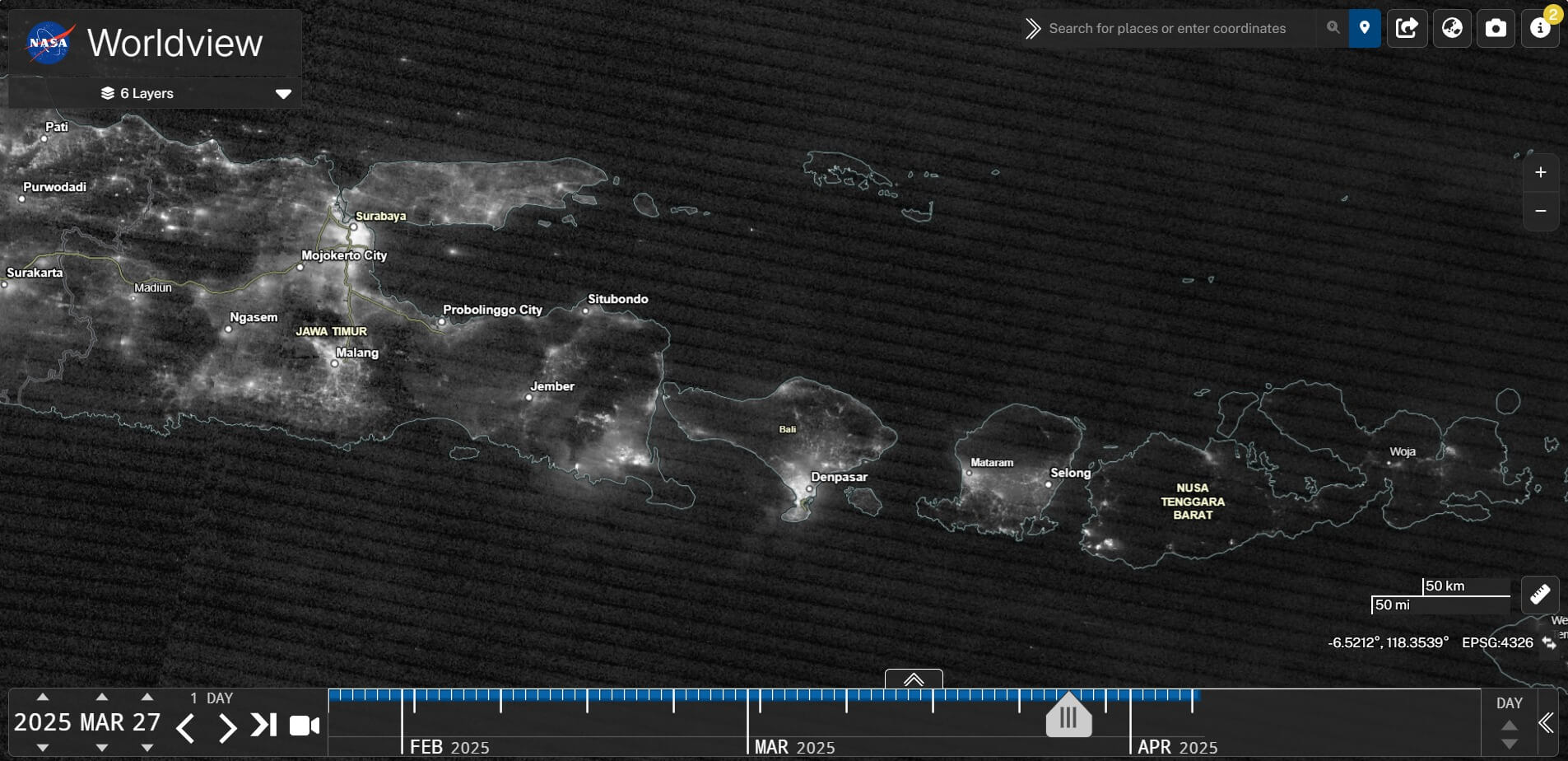


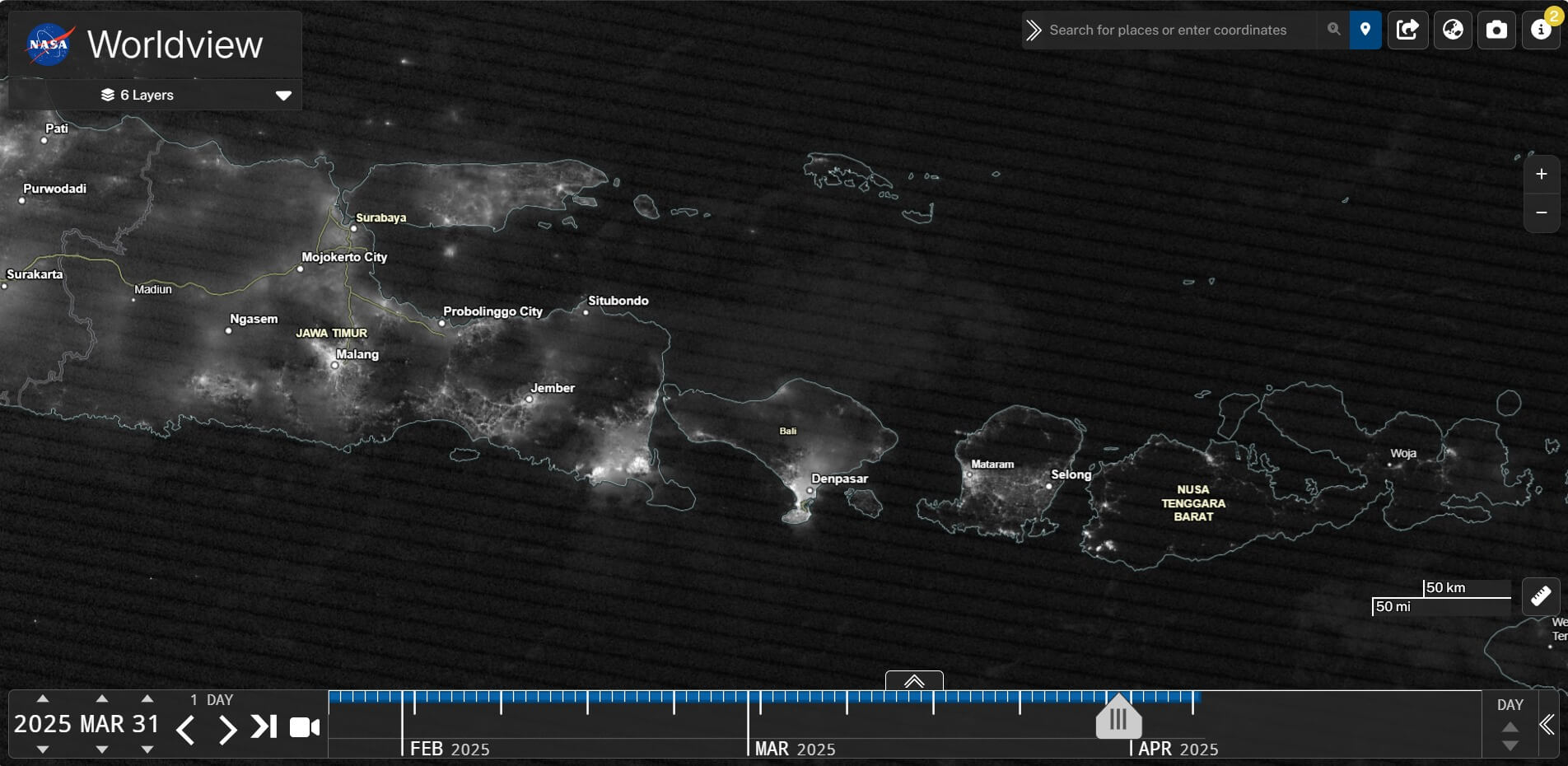
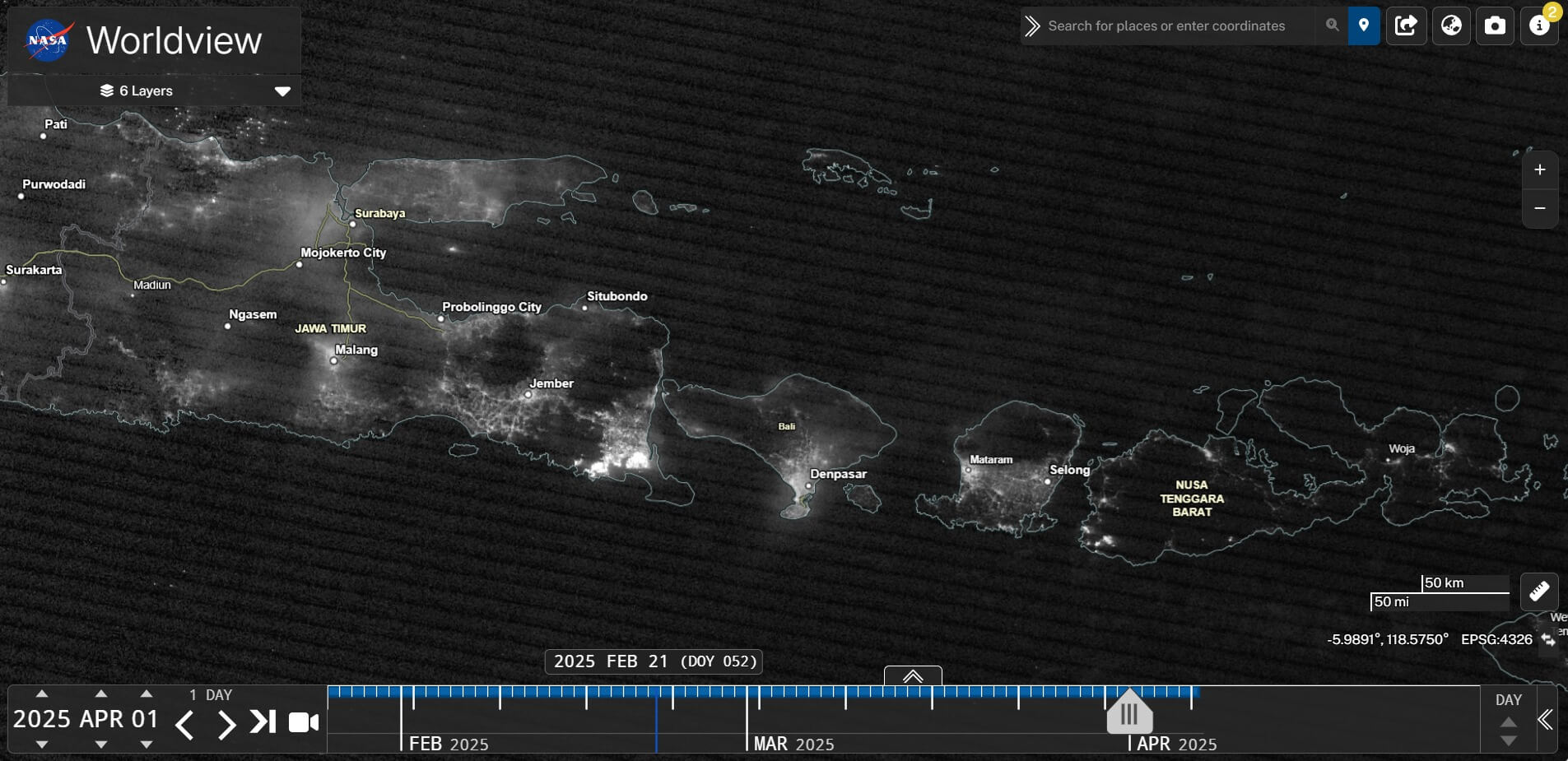
Photos taken from NASA website – https://worldview.earthdata.nasa.gov
The absence of light background is due to a strict ban on the use of any lighting – both outdoors and indoors. In apartments it is recommended to dim the lights or close the windows with curtains.
Now it’s the turn of NOAA (National Centers for Environmental Information) photos. Look at the images from a few days before and after Nyepi Day – the contrast is striking.


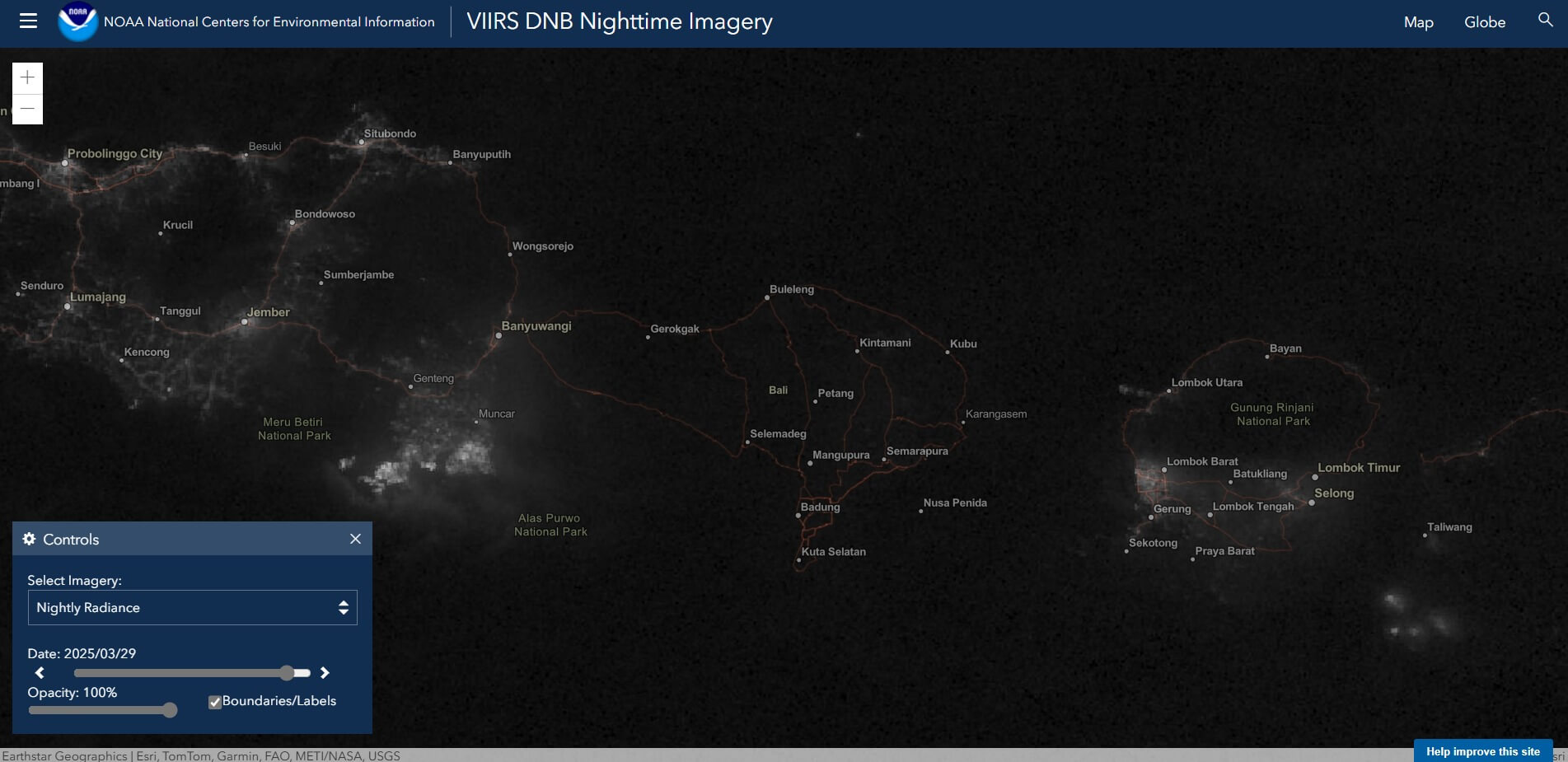
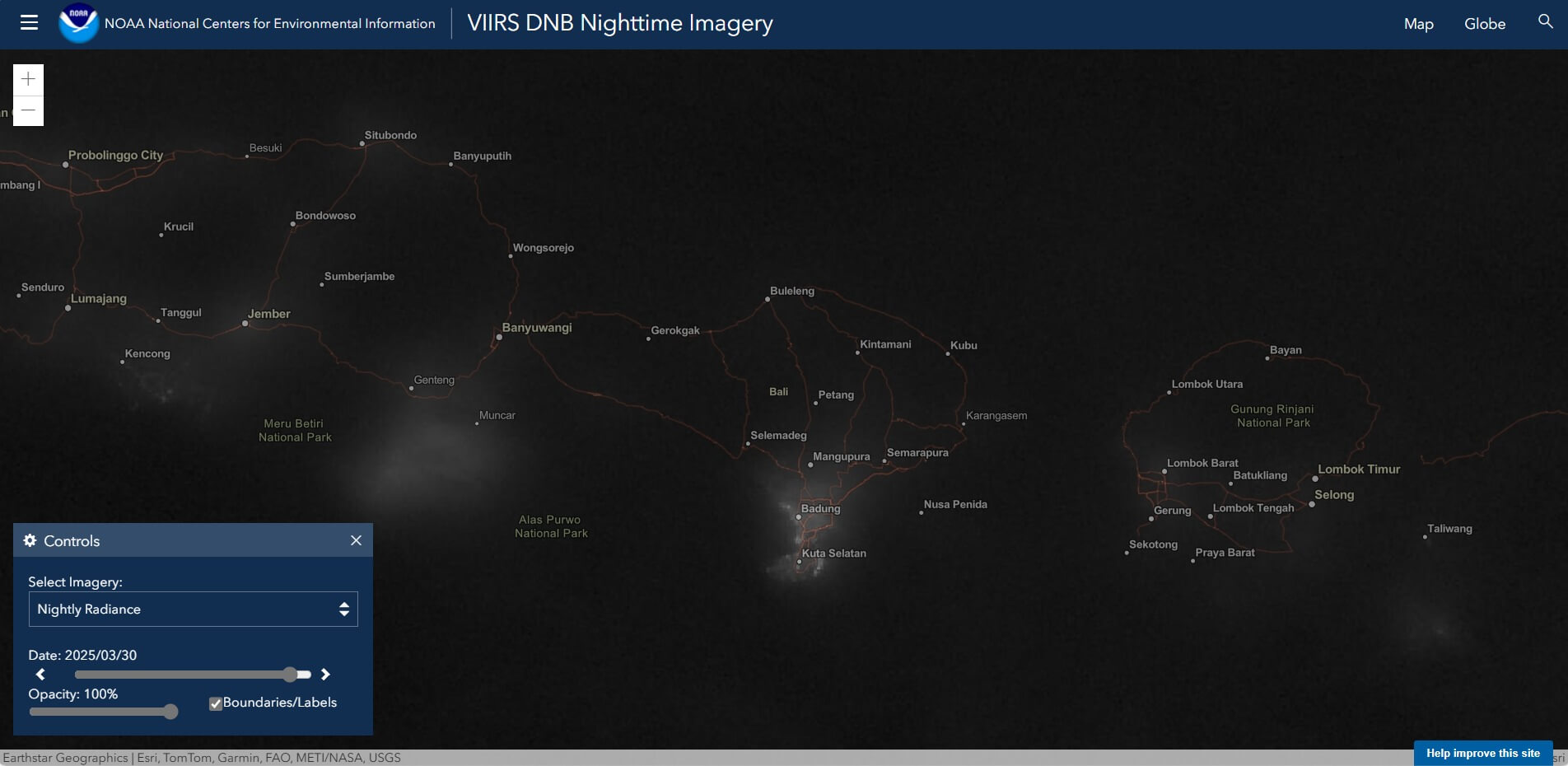

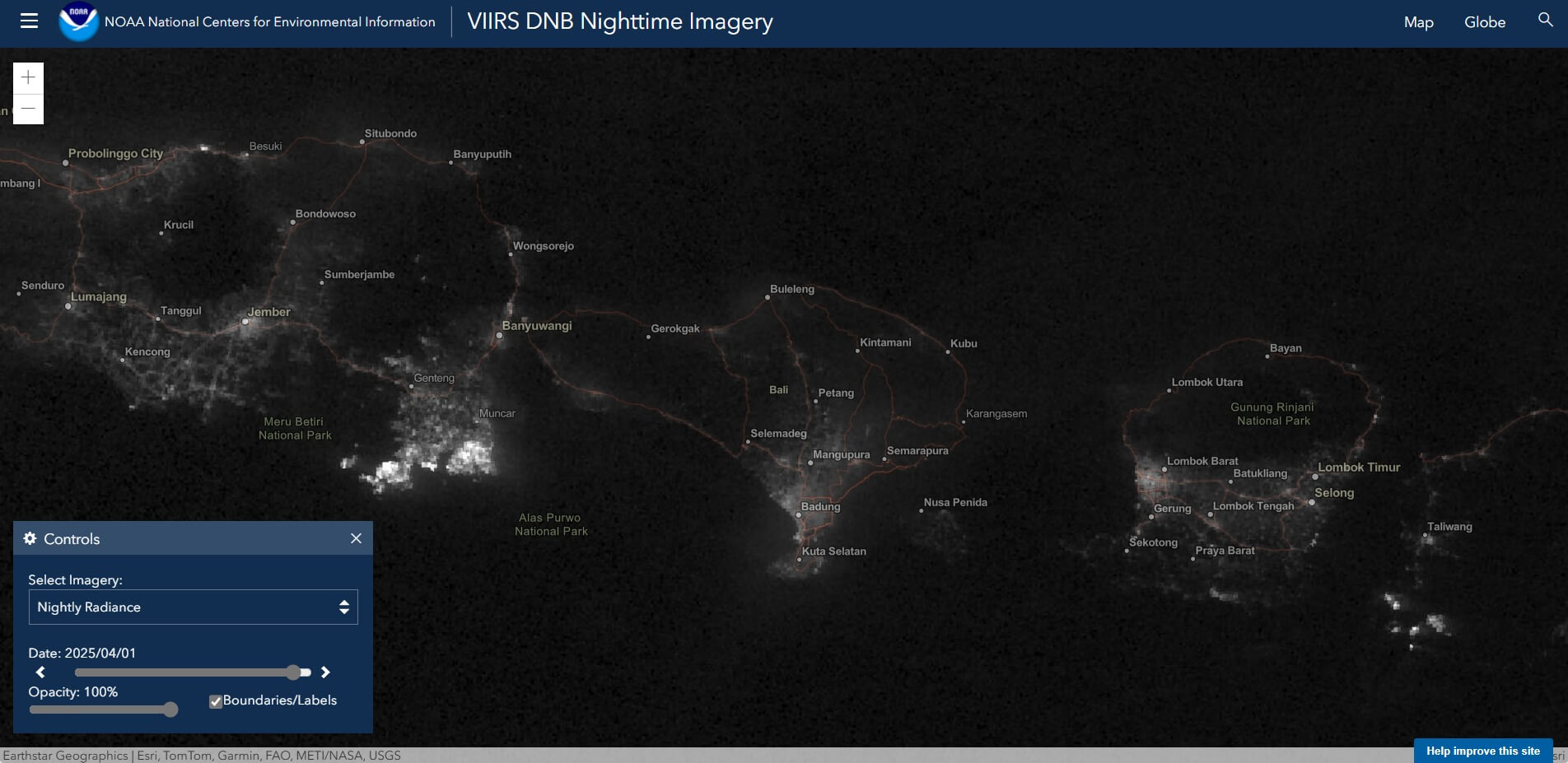
Photos taken from NOAA website – https://www.ncei.noaa.gov
These space images are not just a pretty picture, but a powerful reminder of the power of tradition and its impact on the life of an entire island.
Denpasar airport closed: ban on flights to Nyepi Day from Fly Radar
Another interesting fact about Nyepi Day is the complete cessation of air traffic. Ngurah Rai Airport (Denpasar), which normally receives up to 500 flights daily, comes to a standstill for 24 hours. It is one of the few airports in the world to close for 24 hours for religious reasons.
You could follow this event in real time using services like Flight Radar. In the video below, the 24-hour Nyepi Day is recorded in a sped-up mode. Where you can clearly see Bali’s local airport, Ngurah Rai, not accepting planes from 6am on March 29 to 6am on March 30 (local time). This is not just a restriction, but a deeply rooted tradition that demonstrates respect for spiritual practice and a desire for silence and introspection.
And a graph showing the number of scheduled departures from DPS/WADD Airport per day (UTC time) for the last 30 days in 2025.
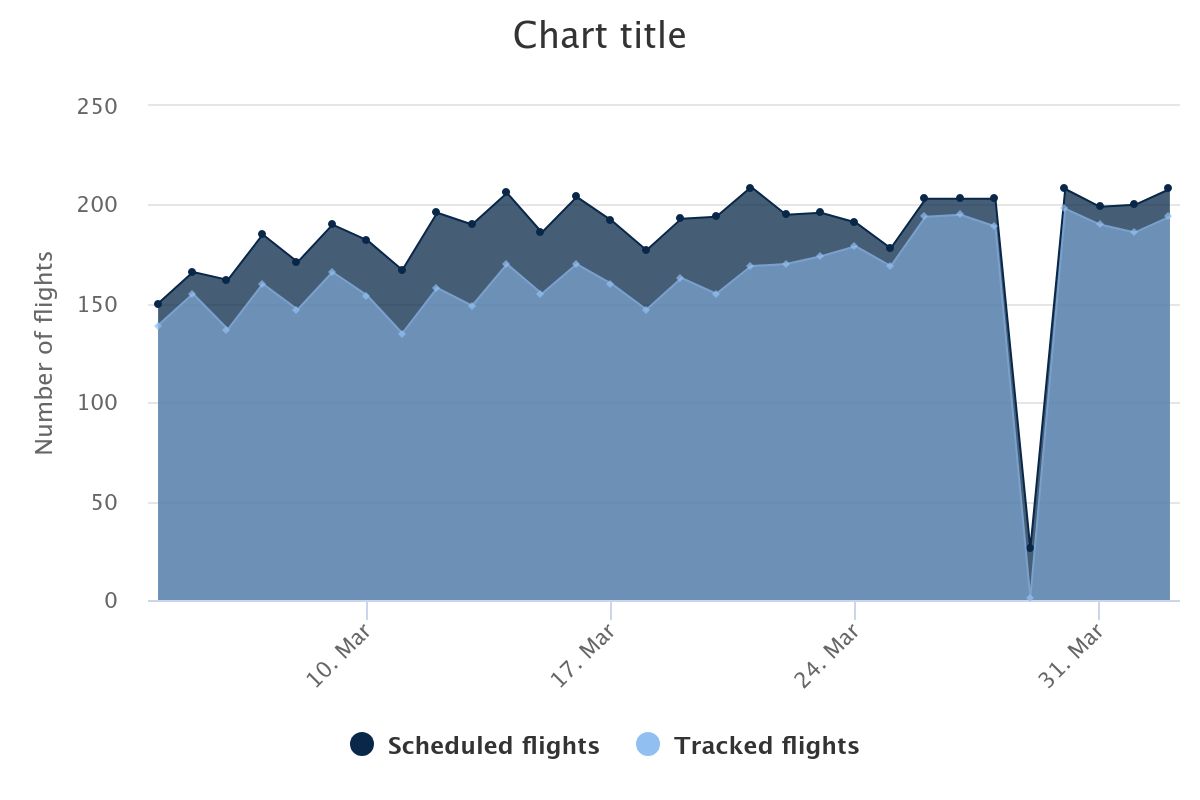
Photo taken from the website – https://www.flightradar24.com
The Nyepi 2025 effect: reducing air traffic in Bali - analyzing 3 years of data
The impact of Nyepi Day on the tourist flow in Bali is obvious. However, I decided to check the information on the number of airplane arrivals in previous years to make sure. And I found these interesting air travel statistics for the last three years. The graph shows that every year in the run-up to Nyepi Day, the number of arrivals at Denpasar Airport drops dramatically. This is due to strict restrictions and the desire of most tourists and locals to honor tradition and pay homage to this unique Balinese practice.
Look at the air travel statistics for 2023-2025: 2-3 days before Nyepi and immediately after, the number of flights at Denpasar Airport drops by 40-60%.
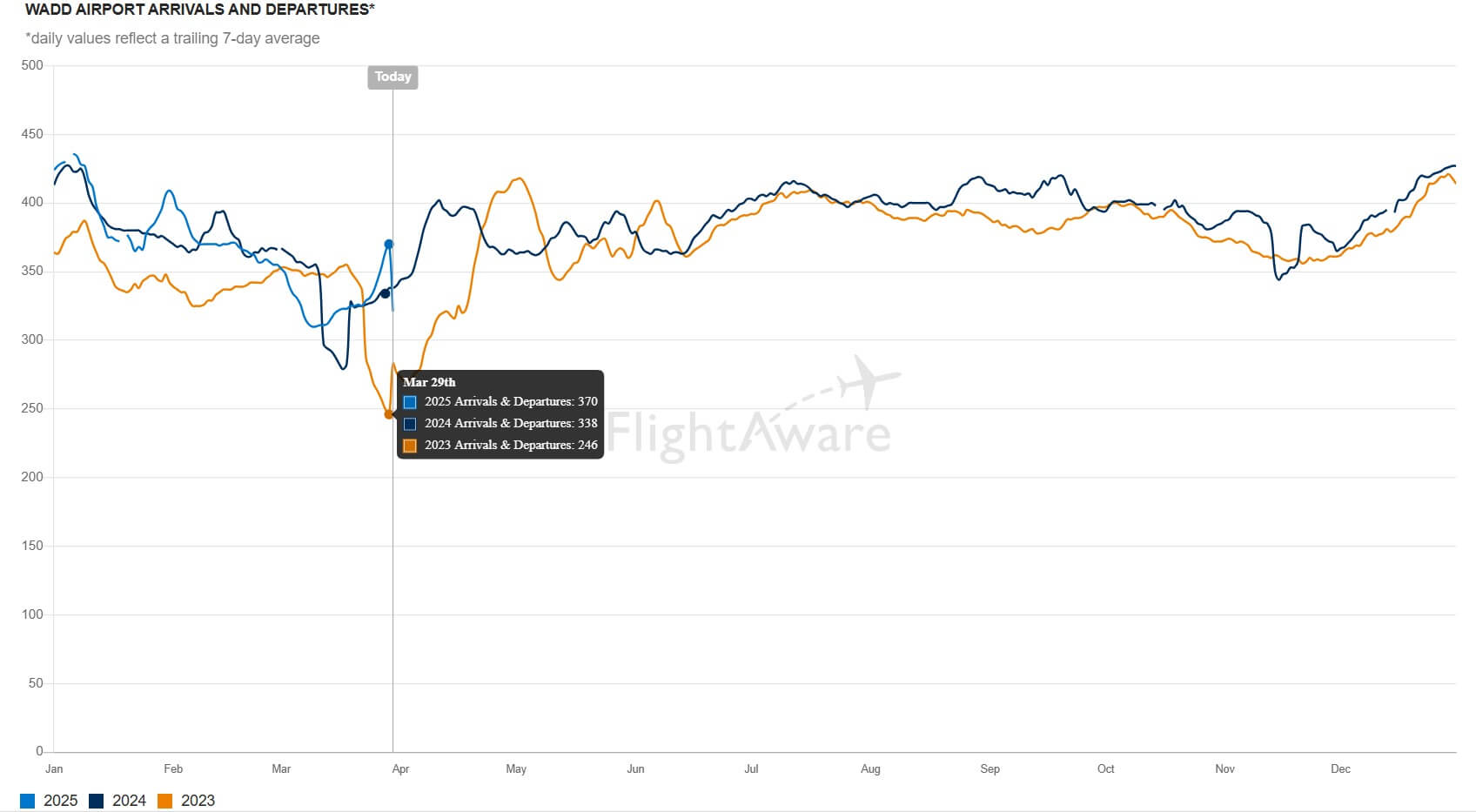
Photo taken from the website – https://www.flightaware.com
Why is this happening?
- Airlines are reducing the number of flights knowing about the ban.
- Online aggregators and other airfare sites warn about Denpasar airport not operating.
- Hotels warn in advance that it is impossible to enter and exit on the Nyepi holiday.
- Tourists fear getting stuck at the airport or getting caught in heavy traffic jams during the Ogoh-Ogoh festival celebrations.
Day of Silence: the eerie silence of the night on Nyepi Day
When you rent a villa, house, or apartment in Bali, one of the main criteria is the neighbors. And I’m not so much talking about people, but about those who really affect your comfort: dogs, roosters, and construction sites. It is these “neighbors” that determine how quiet or, on the contrary, noisy your stay on the island of Bali will be.
Recently I moved to Jimbaran area – it is very cozy here, but there is one nuance: there are really a lot of dogs. They bark day, night, in the heat and rain, and if you are not a fan of sudden night concerts, it is worth considering when choosing accommodation.
Words are hard to capture the atmosphere that is Bali on Nyepi Day. You have to be here in person to feel it. But I tried to convey at least part of this feeling through video. The first video was shot on the night of March 18, 2025, when the dogs were still making their presence known. The second video was taken on the night of Nyepi Day when it suddenly becomes so quiet that even the dogs fall silent.
The difference is staggering. Even in the busiest areas of the island, there is a ringing silence. No cars, mopeds, music, or the usual barking of stray dogs can be heard. It’s a time when you can hear the beating of your own heart well and the dripping air conditioner…
And here’s the interesting thing: if during the day before Nyepi dogs are literally everywhere, then on the Day of Silence itself, they seem to disappear. Where do they disappear to? Are they being taken home? Do they sense the atmosphere of the day and freeze? Or is there some other explanation? If you have any guesses or personal experiences, post them in the comments – I’m very curious myself.
Caught breaking the rules: my encounter with the caretakers of the Nyepi holiday
Nyepi Day is not just about silence, it is also about strict adherence to rules. On this day, special groups of people, known as pecalang, patrol the streets and make sure everyone adheres to the rules.
7 p.m. March 29, I heard on the street, “Excuse me, is anyone here,” insistently, several times. I walk out of the house and see a pecalang standing outside the fence. And suddenly I realize that he’s there because of our lights not being turned off in the street parking lot. The thing is, the lights in our parking lot turn on and off on a timer that the homeowner set up. While I was calling the owner, a second pecalang had already arrived, a neighbor was checking on the light with the staff, and here we were all together trying to turn off the lights in the parking lot.
I was pleasantly surprised that the pecalang helped us without negativity and scolding. Pecalang even helped us tape up the street lights (solar powered) with duct tape.
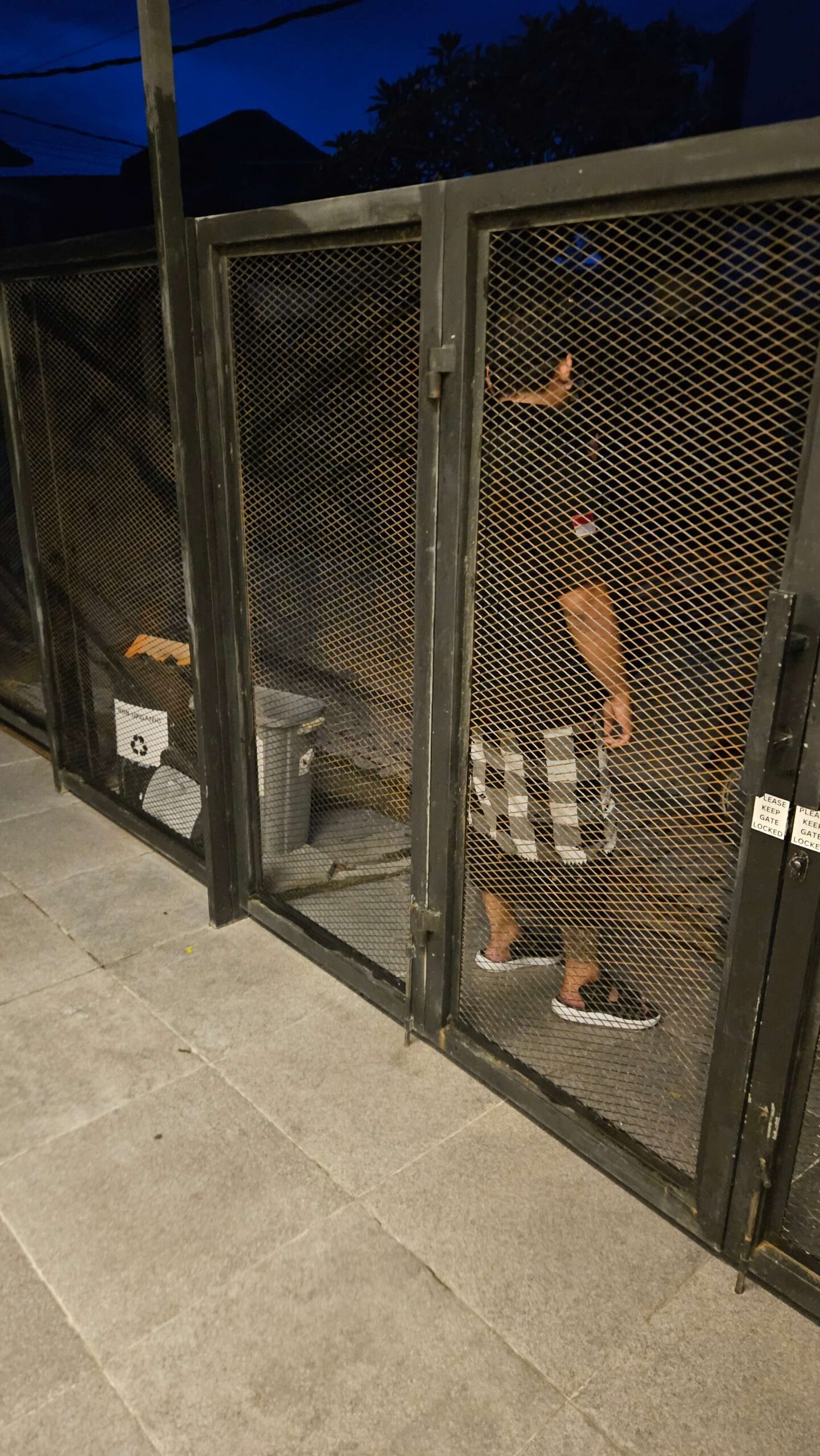
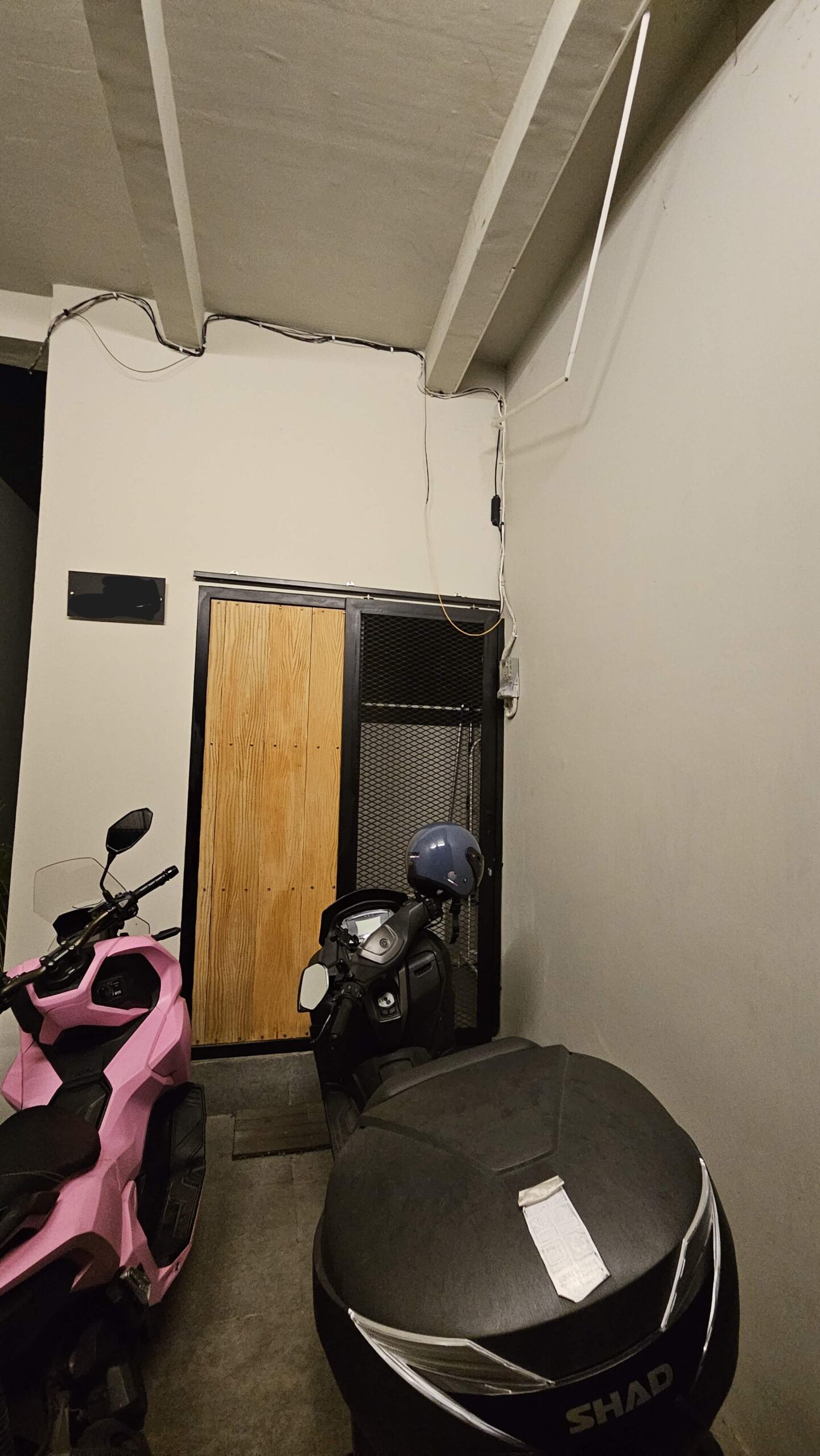


Fortunately, everything went well, but this incident became an important lesson for me and once again reminded me of the need to respect local traditions.
Nyepi holiday: more than just a day of silence - understanding the spiritual heart of Bali
Nyepi is not just a “day off.” It is:
- A day of purification from evil spirits;
- Saka New Year (March 29 in 2025);
- A test of respect for Bali’s culture: even tourists have to respect the rules.
Is it worth traveling to Bali on Nyepi Day? Unequivocally – Yes, if you want a unique experience and are ready for restrictions.
Personal advice: arrive 2-3 days before and stay 1-2 days after – that way you will see the preparations (Ogoh-Ogoh parades) and not miss the renewal of life on the island.
